
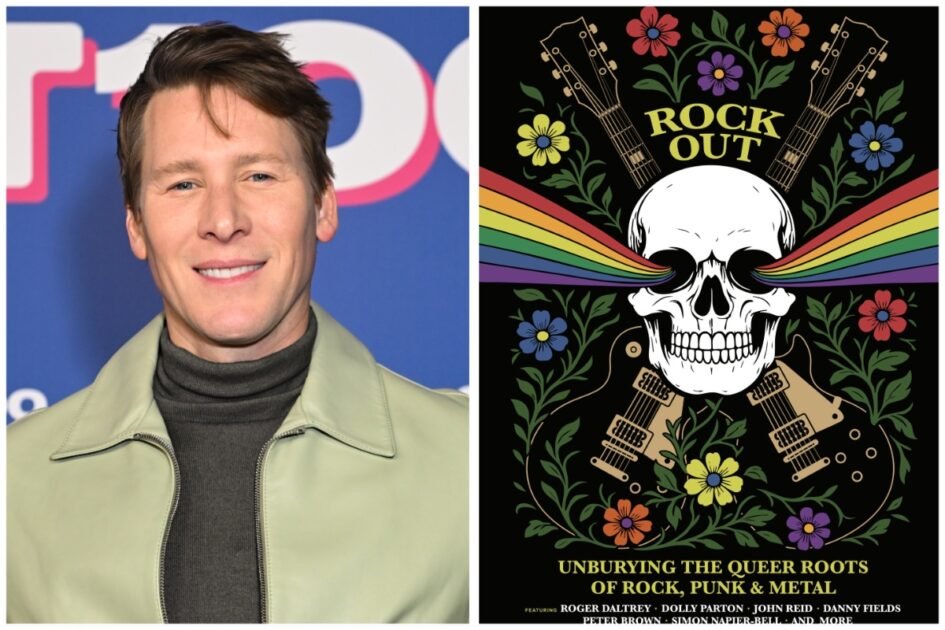

Dustin Lance Black is known for telling powerful stories, but his latest project might be his most personal one yet. The Oscar-winning screenwriter is heading behind the camera for a new documentary titled ‘Rock Out,’ which aims to reclaim the queer history of heavy metal, punk, and rock n’ roll.
While the film features legendary icons and deep musical dives, the heart of the story lies in a heartbreaking conversation Black had with his late brother, Marcus, before he passed away from cancer in .
A Heartbreaking Question
For years, Marcus lived as a closeted queer man who found solace in the gritty worlds of punk and metal. Black recalls his brother as a “black leather-clad” auto mechanic who epitomized the rocker lifestyle. Before his death years ago, Marcus asked a question that stuck with the filmmaker: “Are there any gays like me?”
At the time, Black, despite being one of Hollywood’s most prominent LGBTQ advocates, didn’t have an answer. “I couldn’t think of any group of people I had met or known who were into that music,” Black admits. “The music was so important to my brother.”
Un-Erasing History
‘Rock Out’ serves as the answer Marcus never got to hear. The documentary, which was inspired by a New York Times article by Jim Farber, takes a deep dive into the “homoeroticism” of Elvis Presley’s iconic stage presence and the massive influence of figures like Beatles manager Brian Epstein and Elton John.
One of the most viral moments expected from the film involves Rob Halford, the legendary lead vocalist of Judas Priest. Halford, who came out in , is a focal point of the exploration into how queer identity has always been baked into the DNA of heavy metal, even when it was hidden in plain sight.
Black also tracks down transgender glam rock legend Jayne County. In a captivating interview, County recalls being present at the Stonewall riots, sharing gritty and humorous details about the night that launched the modern LGBTQ rights movement.
A Full-Circle Moment
Perhaps the most emotional revelation in the film involves The Dead Milkmen, which was Marcus’ favorite band. Their music was even playing during his final moments. Black was stunned to discover that the band’s lead singer, Joseph Genaro, is gay—a fact that would have changed everything for his brother.
“My brother would be shocked, and he would just laugh and probably light up a cigarette and just keep laughing for minutes,” Black says. He notes that while the band was once known for using homophobic slurs in their sets, the reality of their identity proves his point: “A queer history had been erased.”
The Fight for Distribution
While the film is set to premiere at the Sheffield DocFest in the U.K. on June , Black acknowledges that getting the documentary onto major streaming platforms is a challenge in the current political climate. He notes that many buyers are “playing it a little safe” due to increasing attacks on the LGBTQ community.
However, the ‘Milk’ writer isn’t backing down. “It’s going to be a bit of a fight to get something like this out there,” he says. “But it’s not the first time. Just to remind people, we got ‘Milk’ made during George W. Bush.”
As for what Marcus would think of the finished product? Black says with a smile, “He’d say, ‘It’s really fucking gay,’ and that would be a compliment because he was punk.”