
















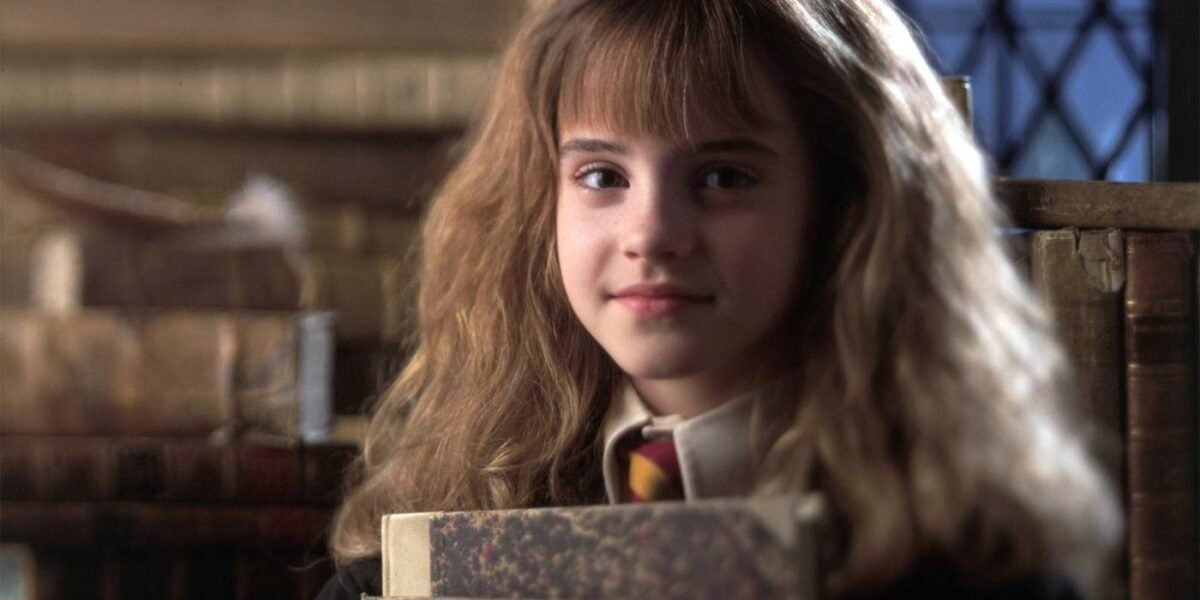

Hermione Granger correcting Ron Weasley's spell pronunciation in Harry Potter and the Sorcerer's Stone (or Harry Potter and the Philosopher's Stone if you live outside the United States, India, and the Philippines) was undoubtedly created as a throwaway moment, but it actually perfectly summarized Hermione's characterization within seconds. Directed by Chris Columbus and distributed by Warner Bros. Pictures, Sorcerer's Stone was the first film adaptation of J.K. Rowling's acclaimed Harry Potter series, which ended with the seventh book, Harry Potter and the Deathly Hallows, in 2007. Emma Watson, Rupert Grint, and Daniel Radcliffe portrayed Hermione, Ron, and Harry, respectively.
Before they successfully fought Voldemort and his Death Eaters in Deathly Hallows' Battle of Hogwarts, Hermione, Ron, and Harry were bright-eyed 11-year-old wizards ready to learn at Hogwarts School of Witchcraft and Wizardry. In their first Charms lesson, taught by Professor Flitwick, the students were tasked with a simple levitation charm, "Wingardium Leviosa". Although Hermione mastered the spell immediately, Ron was not so lucky. In a moment that later became an iconic remembrance of Sorcerer's Stone, Hermione admonished Ron's attempt at magic and pointedly informed him, "You're saying it wrong. It's Leviosa, not Leviosaaa!" Arguably one of the funniest scenes in the entire Harry Potter film franchise, the moment not only shows the difference between two wizards, but provides a tremendous amount of insight as to who Hermione is, and how she operates.
Hermione Granger's Role In Sorcerer's Stone
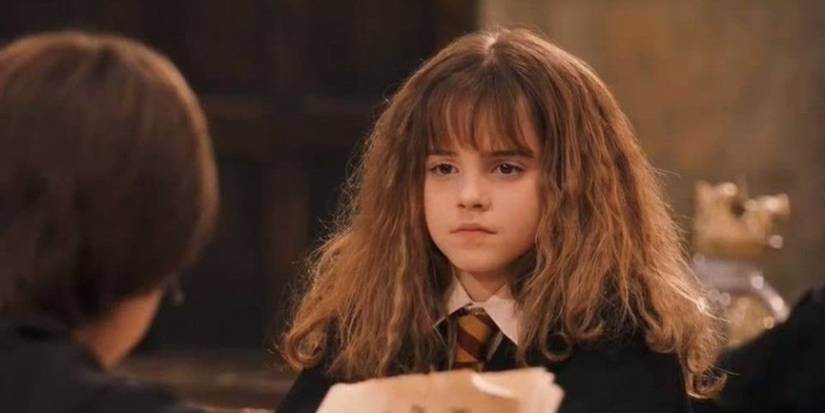
Hermione Granger looks at Harry Potter with a condescending expression.
Hermione first met Ron and Harry on the Hogwarts Express as the train took them to their first year at school, and from the moment the three locked eyes, it was a two against one situation. Hermione was immediately introduced as a confident 11-year-old with for sure natural abilities, although her abrasive personality also shone, considering Hermione criticized Ron's attempt at magic before even asking what his name was. As the group was sorted into Gryffindor and began their official studies at Hogwarts, Ron and Harry continued to try and keep their distance from Hermione. While Hermione carried herself as if the isolation from the rest of the students didn't hurt, a pivotal moment that shifted the direction of Sorcerer Stone showed Hermione crying after overhearing Ron talking about her.
Harry, Ron, and Hermione officially became the Golden Trio after Harry and Ron saved Hermione from a rogue troll, who stumbled into the very bathroom where Hermione sat crying. Hermione lied to protect Harry and Ron in return, and from that moment, they were inseparable. With Harry's dedication, Ron's loyalty, and Hermione's intelligence, the first-years managed to infiltrate the area where the resurrection stone was being protected, although only Harry made it to the end to face off against Professor Quirrell. By the end of Sorcerer's Stone, Hermione, Ron, Harry, and Neville Longbottom earned Gryffindor enough house points to earn the House Cup, with the last shot of the film showing Harry's gratitude for the Wizarding World. Despite how Hermione was initially introduced, her character grew tremendously in just one movie alone. She was famously almost sorted into Ravenclaw, but Hermione proved by the end of Sorcerer's Stone that she was a Gryffindor through and through.
"The Brightest Witch of Her Age" is an Accurate Nickname for Hermione
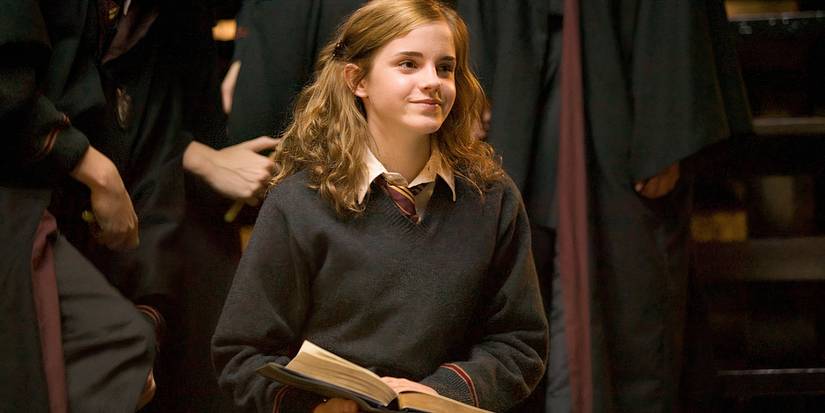
Hermione Granger holding a book and smiling in the movie Harry Potter and the Goblet of Fire
Based on just the quick exchange between Ron and Hermione in Sorcerer's Stone, the most obvious thing about the Harry Potter character is that she is extremely intelligent. While only referred to as a genius when she helps Harry and Ron with their homework, Hermione is frequently lauded for her book-smartness throughout the series. In the first six Harry Potter books, before the Golden Trio drops out of Hogwarts to look for Horcruxes, Hermione is almost always the student to answer questions in lessons. Hermione is also (almost always) the first student to learn, and then master, a new spell. Hermione's resourcefulness goes hand-in-hand with her intellect. Hermione can always be spotted with some sort of book, and no matter what the book is (see: The Tales of Beetle the Bard, introduced in Deathly Hallows), Hermione always manages to get some sort of lesson out of the text.
Hermione's attempt to help Ron in Sorcerer's Stone also reveals that Hermione is naturally bossy, and while the Harry Potter character usually has good intentions, her book-smartness doesn't always translate into street-smartness. Before Harry and Ron eventually warmed up to Hermione (more so in the book than in the film, which was condensed for time), the boys were frequently annoyed by her know-it-all attitude and unsolicited advice. Hermione has a solid head on her shoulders with a well-used brain, but there are times, as clearly displayed in Sorcerer's Stone, where Hermione doesn't read the room before opening her mouth. Hermione's bossiness ultimately derives from a place of loyalty, however, especially concerning Ron and Harry. Throughout the series, with perhaps too many examples to note, Hermione found herself at odds with her best friends, but would agree to help them anyway.
Up until Deathly Hallows, Hermione made it abundantly clear to everyone at Hogwarts that she highly valued the educational system. In Sorcerer's Stone, this was one of the most apparent aspects of her personality. While her classmates would slack off, give up, or generally act unenthusiastic in the first lessons showcased in Harry Potter, one could always spot Hermione, in or out of the main frame, working intently on trying to master the lesson. As a muggle-born getting her first real taste of magic, Hermione's rigidity and perfectionism shouldn't be too surprising. After all, one of Hermione's most iconic quotes in the entire Harry Potter series is from Sorcerer's Stone: "I'm going to bed, before either of you come up with another clever idea to get us killed – or worse, expelled."
Hermione Granger's Impact On The Harry Potter Series
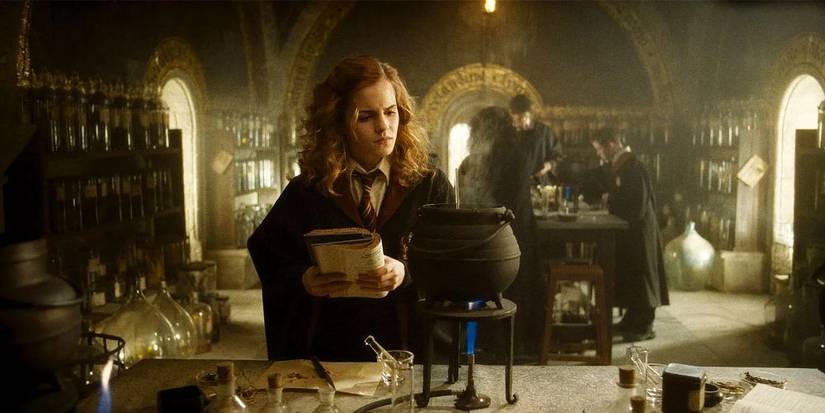
Hermione Granger, played by Emma Watson, brews a potion in Harry Potter and the Half-Blood Prince.
Harry may be the Chosen One, but there's no doubt that Hermione is the real brain of the operation. If there's a problem needing to be solved, Harry and Ron know (and sometimes take advantage of the fact) that Hermione will always be able to come up with a solution. Hermione successfully figured out how to get past the three-headed dog, Fluffy, and the Devil's Snare in Sorcerer's Stone, for instance. Hermione also figured out how to utilize a time-turner to not just attend extra lessons at Hogwarts, but then travel back in time to save Sirius Black and Buckbeak in Prisoner of Azkaban. Harry and Ron got themselves out of plenty of situations throughout the series, but it was Hermione's intellect and intuition that routinely solved the trio's continuous predicaments.
Gryffindors pride themselves on bravery and chivalry, but one can argue that Hermione has the highest moral compass among herself, Harry, and Ron. The Golden Trio all displayed the same characteristics and went out of their way to save the day, even when the person that needed saving was their enemy (Draco Malfoy definitely would've perished in Deathly Hallows without them). One Harry Potter book storyline that was cut from the films, however, was that Hermione took extreme pity on House Elves and formed the Society for the Promotion of Elfish Welfare (S.P.E.W.) in an unrelenting quest to free them.
Hermione's high sense of justice is commendable, but what's even more commendable is how many times Hermione saved Harry's life throughout the Harry Potter series—and that's not an exaggeration. Harry put his life on the line the most, being the Boy Who Lives and all, but Hermione directly prevented Harry from meeting an untimely end several times. Three standout moments where Hermione saved Harry's life (although there are more) include Hermione lying to Professor Umbridge just before she was about to cast the Cruciatus Curse on Harry (Order of the Phoenix), disfiguring Harry's face before being confronted by poachers (Deathly Hallows), and fighting Nagini, Voldemort's snake who was in the deceased body of Bathilda Bagshot, off of Harry (Deathly Hallows).
All in all, Hermione's greatest contribution to the Harry Potter series is that she's one of the most influential female characters ever invented, especially for younger generations. Hermione and Ron eventually get together and are married with children by the epilogue of Deathly Hallows, but Hermione was never written or portrayed as a supporting character meant to serve as a love interest. Hermione was never written to fade into the background and prop her male friends up; in fact, Hermione was frequently given moments to shine. As one of the smartest wizards and an equally impressive dueler, Hermione's character development throughout the Harry Potter series proved to the masses that females can be just as involved in the action as male protagonists and still retain their femininity.


